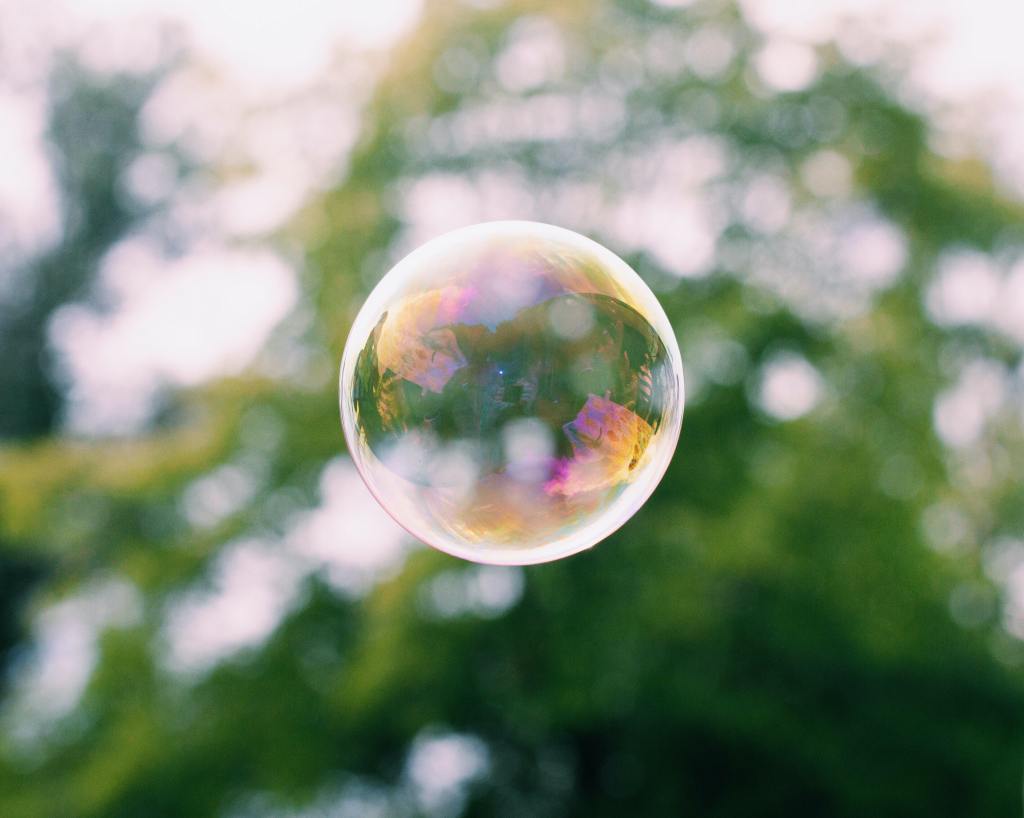
On a recent warm afternoon on my porch in the Santa Cruz Mountains, I spent a few minutes entertaining my 14-month-old son by blowing bubbles for him. He shrieked as I sent streams of the shimmering orbs into the air, but despite the perfect weather and my child’s joyful laughter, I found myself feeling melancholy. Oddly enough, it was a sensation I had anticipated from the moment I picked the green bottle of bubble solution up off the drugstore shelf.
It all goes back to my early teenage years in the late 1990s. That’s when, one day, an unknown singer-songwriter named Macy Gray released the single “I Try,” and for a while, it felt like it was everywhere: movie trailers, tv promos, top 40 radio, the grocery store. If a place had music, there’s a good chance “I Try” found its way into it.
The success was well-deserved. It’s a great song and Macy Gray’s near-alien voice was soulful and different from anything else of the era. In the song’s chorus, she sings:
I try to say goodbye and I choke
I try to walk away and I stumble
Though I try to hide it, it’s clear
My world crumbles when you are not here.
Unfortunately, at the time, I never quite caught that last line. She sings the phrase “My world crumbles” in a garbled way, and I could never make out exactly what she was saying. I thought it went:
Though I try to hide it, it’s clear
I blow bubbles when you are not here.
One could argue that my interpretation makes no sense, but to this day I think it’s beautiful and profound. I had an image in my head of Ms. Gray, sitting alone on the swings at the park, dragging her shoes in the dirt with no one to push her. She’d stare straight ahead for a moment then lift a plastic wand out of a bottle, draw it to her lips, and send a lazy stream of bubbles into the sky – watching with sadness as they’d float away and gradually pop into droplets of soapy water.
I blow bubbles when you are not here.
And why wouldn’t she? Blowing bubbles, after all, is a perfect way to accessorize a sigh. It’s a near-silent activity that can be performed repetitively and with high levels of numbness, and a bubble’s short lifespan puts it in the center of a Venn Diagram where “hope” and “anticipation of loss” overlap in a large oval with a permeable membrane. I’m surprised there’s no German word that translates into “The feeling of when you are blowing bubbles because you are without a person you love.”
The saddest thing about bubbles, of course, is that their survival rate is exactly zero. Against the backdrop of a changing climate and the scorched redwood forest visible from my deck – a scar of 2020’s CZU Lightning Fire – the bubbles seem to be teaching my young child a hard lesson about life. The beautiful things in this world are only temporary.
My son hasn’t heard “I try,” and hasn’t been poisoned by the secret darkness of misheard Macy Gray lyrics. To him, the bubbles are magical and joyful. It’s an odd juxtaposition: Myself, an elder millennial bruised by decades of televised trauma from the Oklahoma City bombing to 9/11 to January 6 – and another, a child of a pandemic whose life has thus far been sheltered and mostly socially distant. He shrieks in anticipation of the bubbles leaping from the wand as I blow them, and I feel a sinking dread for the moment they pop.
That’s the thing about bubbles, I guess.
 Surrealist Nonfiction
I think I also thought it was “Blow Bubbles.” But I interpreted it as some kind of weird clown thing that she had going on.
LikeLike